
Dizziness has a cause. Here’s how balance testing helps identify it and guide treatment.
Dizziness is one of the most common complaints in medicine — and one of the most frustrating to navigate. Patients describe it differently: spinning, floating, swaying, a sense that the ground is shifting underfoot. Doctors hear it and think of dozens of possible causes. The gap between symptom and diagnosis can feel enormous.
Vestibular testing exists to close that gap. It transforms a subjective complaint into measurable data — giving both patient and clinician something concrete to work with.
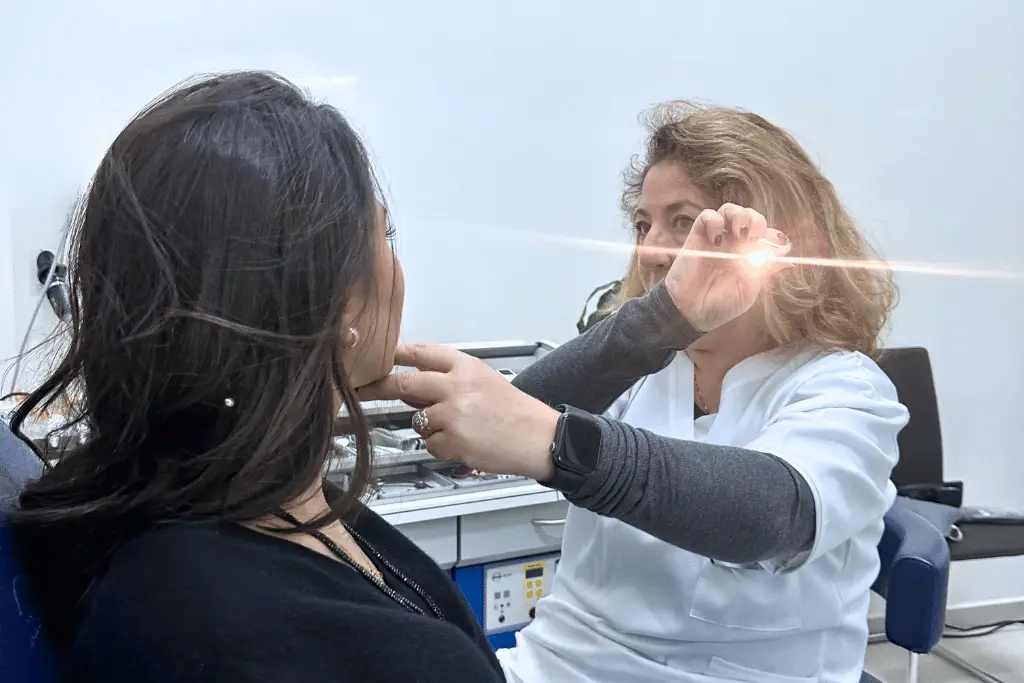
The vestibular system is the body’s balance headquarters. Housed in the inner ear, it continuously sends signals to the brain about head position and movement. When something disrupts it — infection, degeneration, injury — the brain receives conflicting information and dizziness follows.
The challenge is that many vestibular disorders produce overlapping symptoms. Vertigo, imbalance, and spatial disorientation can all stem from very different origins: a displaced crystal, an inflamed nerve, reduced blood flow to the brainstem, or a central neurological condition. A clinical exam can narrow the possibilities — but vestibular testing is often what confirms the diagnosis. Without it, treatment becomes guesswork.
Vestibular tests don’t look at the ear visually. They measure function — how well the inner ear detects movement, how accurately it communicates with the brain, and how the eyes respond to those signals.
The vestibulo-ocular reflex (VOR) is central to this. It’s the automatic mechanism that stabilizes your vision when your head moves. When the vestibular system is damaged, this reflex breaks down — and the eyes reveal it. Most vestibular tests are sophisticated ways of measuring eye movement in response to controlled inner ear stimulation.
Video-nystagmography (VNG) is among the most widely used assessments. The patient wears infrared goggles that track eye movements precisely during a series of tasks — including caloric testing, where warm and cool air is introduced into each ear canal separately. This allows each ear to be assessed independently, revealing unilateral vestibular deficits consistent with conditions like vestibular neuritis.
Video Head Impulse Test (vHIT) tests the VOR directly. The clinician makes small, rapid head rotations while cameras track eye movement. In a healthy system, the eyes stay on target. When the inner ear is damaged, they slip and a corrective saccade appears — revealing which canal is affected and to what degree.
Vestibular Evoked Myogenic Potentials (VEMP) target a different part of the system: the otolith organs, which detect gravity and linear movement. Cervical and ocular VEMP tests help identify conditions affecting these pathways, including certain forms of Ménière’s disease.
Electrocochleography (ECoG) measures electrical activity in the cochlea and is primarily used to detect the fluid pressure abnormality underlying Ménière’s disease — making it a key diagnostic tool when that condition is suspected.
Posturography measures balance control under varying conditions by removing visual and sensory cues one by one, isolating the vestibular contribution. It’s especially useful for tracking rehabilitation progress.
A well-interpreted test battery can answer the questions that matter most: Is the problem in the inner ear or the central nervous system? Is one side more affected? Is the damage acute or chronic? Is the system compensating?
These distinctions directly shape treatment. A unilateral peripheral deficit may call for vestibular rehabilitation. A central finding may require urgent neurological investigation. BPPV responds to repositioning maneuvers. No single test tells the full story — the value lies in combining results with clinical history.
Vestibular testing is particularly valuable when dizziness has persisted beyond a few weeks, when the cause remains unclear, when asymmetric hearing loss is present, when a patient has fallen, or when treatment isn’t working as expected. It’s also recommended before vestibular rehabilitation begins — to ensure therapy targets the right deficit.
Dizziness doesn’t have to remain a mystery. The vestibular system can be tested and mapped with a precision most patients don’t realize is available. A structured test battery can identify where the problem is, how severe it is, and what to do about it.
If you’ve been living with unexplained dizziness, vestibular testing may be the step that finally turns your symptoms into answers.
Post Tags :
Share :

Clarity and care for vertigo, balance, hearing, and sleep symptoms.
Copyright © 2026 by Keshrise